Introduction
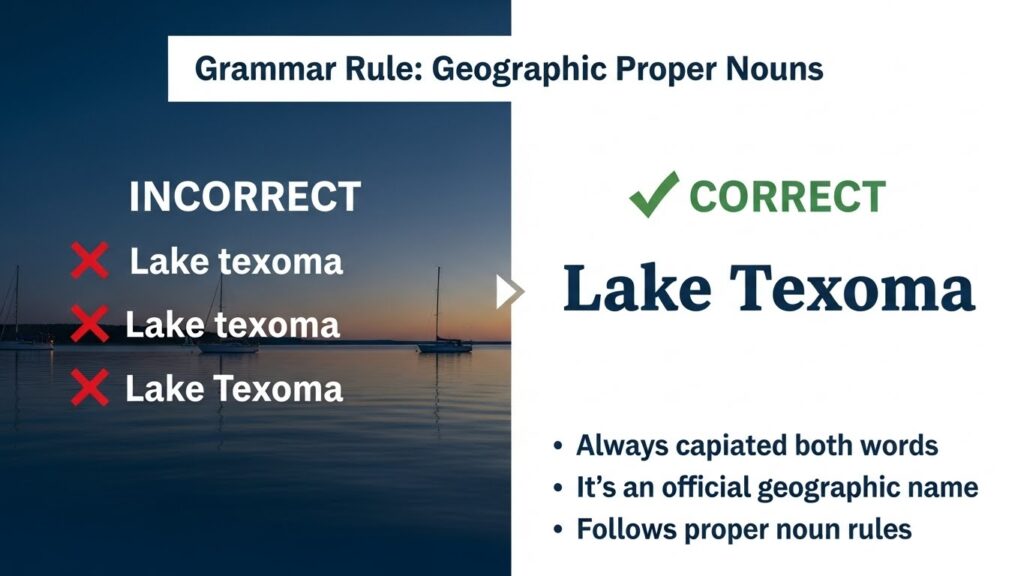
When writing about one of America’s largest reservoirs straddling the Texas-Oklahoma border, a common question arises: should “Lake Texoma” be capitalized? The answer is unequivocally yes—Lake Texoma should be capitalized because it’s a proper noun, specifically naming a distinct geographic location. This isn’t merely a stylistic preference; it’s a fundamental rule of English grammar that applies to all named bodies of water, from the Pacific Ocean to the Mississippi River to Lake Texoma itself.
Understanding when and why to capitalize geographic names is essential for writers, students, business professionals, and anyone who wants to communicate clearly and correctly. Proper capitalization demonstrates attention to detail, respect for established naming conventions, and professional writing standards. When you capitalize Lake Texoma correctly, you’re acknowledging it as a specific, officially recognized place rather than treating it as a generic description.
The capitalization of Lake Texoma follows the same principles that govern the capitalization of other proper nouns in American English. Just as we capitalize New York City, Mount Rushmore, or the Grand Canyon, we must capitalize Lake Texoma because these are official names that distinguish specific locations from all others. This article will explore the grammatical foundations for why Lake Texoma should be capitalized, examine common mistakes writers make, and provide comprehensive guidance on proper noun usage for geographic locations. Whether you’re writing a travel blog, academic paper, real estate listing, or social media post about this popular recreational destination, mastering these capitalization rules will elevate your writing and ensure grammatical accuracy.
Understanding Proper Nouns and Geographic Names
Proper nouns are specific names given to particular people, places, or things, distinguishing them from general categories. In English grammar, proper nouns always require capitalization regardless of where they appear in a sentence. Lake Texoma falls squarely into this category as a proper noun because it names a specific reservoir created by the Denison Dam on the Red River. The word “lake” becomes part of the official name, transforming from a common noun (which would remain lowercase in phrases like “the lake near my house”) into part of a proper noun that must be capitalized. The United States Board on Geographic Names, the federal body responsible for maintaining uniform geographic name usage throughout the government, officially recognizes “Lake Texoma” with both words capitalized. This designation carries significant weight in establishing standard usage across maps, official documents, and publications.
Geographic proper nouns serve a critical function in language by providing precise identification of locations. Without proper capitalization, readers might momentarily confuse whether a writer is discussing a specific named location or making a general reference. This distinction matters greatly in contexts ranging from legal documents describing property boundaries to travel articles guiding tourists to specific destinations. Lake Texoma should be capitalized to immediately signal to readers that you’re referring to the particular 89,000-acre reservoir spanning Grayson and Cooke counties in Texas and Bryan, Marshall, and Love counties in Oklahoma, not just any lake in the Texoma region. The capitalization convention extends beyond the United States to English usage worldwide, creating consistency that helps writers, editors, and readers maintain shared understanding across different types of writing, from journalism to academic research to creative nonfiction.
Read More: Soinducorpsetdesmains
The Grammar Rules Behind Capitalizing Lake Texoma
The fundamental grammar rule that requires Lake Texoma to be capitalized stems from the broader principle that proper nouns—names of specific entities—always begin with capital letters. This rule appears in every major English style guide, including the Chicago Manual of Style, Associated Press (AP) Stylebook, and Modern Language Association (MLA) guidelines. These authoritative references consistently state that geographic locations bearing official names must be capitalized in their entirety, making it grammatically incorrect to write “lake texoma” or “Lake texoma” with any portion in lowercase. Breaking down the name component by component reveals why both words require capitalization. “Lake” isn’t functioning as a generic descriptor here; instead, it forms an integral part of the proper name that officially identifies this specific body of water. Similarly, “Texoma” is a portmanteau derived from “Texas” and “Oklahoma,” the two states this reservoir spans, and represents a coined proper name rather than a common word found in dictionaries.
The capitalization requirement remains constant regardless of the grammatical function Lake Texoma serves within a sentence. Whether it appears as the subject (“Lake Texoma attracts millions of visitors annually”), the object (“I visited Lake Texoma last summer”), or within a prepositional phrase (“fishing at Lake Texoma”), the name maintains its capitalization. This consistency differentiates proper nouns from common nouns, which change capitalization depending on sentence position—for instance, “The lake was beautiful” uses lowercase because “lake” functions as a common noun describing any unspecified body of water. English grammar recognizes several categories of proper nouns that always require capitalization: personal names, place names, organizational names, brand names, and specific event names. Lake Texoma should be capitalized because it fits definitively within the place names category, representing a distinct geographic entity with legal, cultural, and practical significance to millions of residents and visitors who interact with this reservoir annually.
Common Capitalization Mistakes with Lake Names
Despite clear grammatical rules, writers frequently make capitalization errors when writing about Lake Texoma and similar geographic features. One prevalent mistake involves capitalizing only “Lake” while leaving “Texoma” in lowercase, producing the incorrect form “Lake texoma.” This error typically stems from confusion about whether “Texoma” qualifies as a proper name or from simple typographical oversight. However, since “Texoma” represents the specific identifying portion of this reservoir’s name—distinguishing it from Lake Superior, Lake Michigan, or any other lake—it must always be capitalized as an essential component of the complete proper noun. Another common error occurs when writers use lowercase for the entire name, writing “lake texoma” as if referring to a generic body of water rather than a specific named location. This mistake often appears in casual writing contexts like text messages, informal emails, or social media posts where writers may feel capitalization rules matter less.
Some writers inconsistently capitalize Lake Texoma throughout a single document, alternating between correct capitalization and lowercase versions. This inconsistency creates confusion and signals editorial carelessness to readers. Whether you mention Lake Texoma once or fifty times in a piece of writing, the capitalization must remain uniform throughout. Style guides universally emphasize consistency in proper noun treatment, recognizing that readers notice and are distracted by variations in how the same entity is presented. Autocorrect features in word processing software and mobile devices sometimes contribute to capitalization errors with Lake Texoma. If “Texoma” isn’t recognized by the device’s dictionary, autocorrect may change it to lowercase or suggest alternative spellings. Writers must remain vigilant when technology makes unwanted changes to proper nouns, and most devices allow users to add custom words to their personal dictionaries, preventing future autocorrect interference and ensuring Lake Texoma should be capitalized correctly every time.
Lake Texoma in Professional and Academic Writing
In professional and academic contexts, correct capitalization of Lake Texoma carries particular importance because these writing environments demand precision and adherence to established grammatical standards. Research papers, scientific studies, environmental reports, and government documents about water quality, recreation management, or economic impact all reference Lake Texoma with proper capitalization to maintain credibility and professionalism. Academic style guides such as APA (American Psychological Association), MLA, and Chicago all require that geographic proper nouns be capitalized consistently throughout scholarly work. A researcher writing about “lake texoma” in a peer-reviewed journal article would likely face editorial correction before publication, as such errors undermine the author’s authority and distract from the substantive content of the research.
Business writing related to Lake Texoma—including real estate marketing materials, tourism brochures, marina operations documentation, and economic development proposals—must also observe proper capitalization conventions. When property listings advertise “lakefront homes on lake texoma,” the lowercase treatment signals unprofessionalism and may reduce buyer confidence in the listing agent’s attention to detail. Conversely, correctly writing “Lake Texoma waterfront property” demonstrates professionalism that resonates with educated buyers and sellers. In corporate communications, grant applications, and partnership proposals involving Lake Texoma resources or tourism initiatives, proper capitalization reflects organizational competence and respect for grammatical standards. These professional contexts illustrate why Lake Texoma should be capitalized not merely as a grammar exercise but as a practical matter of credibility, clear communication, and professional presentation that can influence business outcomes and academic reputation.
Historical Context and Official Naming of Lake Texoma
Lake Texoma was created in 1944 when the U.S. Army Corps of Engineers completed construction of the Denison Dam on the Red River, and from its inception, the reservoir received its official designation as “Lake Texoma” with proper noun capitalization. The name itself represents a creative portmanteau blending “Texas” and “Oklahoma,” both of which are proper nouns requiring capitalization, making it logical that their combination would similarly demand capital letters. This official naming decision by the Army Corps of Engineers and subsequent recognition by the U.S. Board on Geographic Names established the authoritative form that all subsequent references should follow. Historical documents, engineering reports, and government records from the 1940s onward consistently show “Lake Texoma” with both words capitalized, creating a documented standard that has persisted for eight decades.
The historical precedent for capitalizing Lake Texoma matters because it establishes continuity in how this geographic feature is identified across generations of documents, maps, and publications. When modern writers capitalize Lake Texoma correctly, they’re maintaining consistency with thousands of historical references spanning military records, geological surveys, property deeds, tourism publications, and news articles. This continuity serves important practical functions, particularly in legal contexts where property descriptions must precisely match historical documents, and in archival research where scholars need to locate all references to this reservoir across decades of materials. Understanding that Lake Texoma should be capitalized because of its official naming history helps writers recognize that capitalization isn’t arbitrary but reflects documented, authoritative decisions made by federal agencies responsible for geographic naming standards. This historical foundation reinforces the grammatical imperative to capitalize Lake Texoma in all contemporary writing contexts.
Comparing Lake Texoma to Other Geographic Proper Nouns
Examining how Lake Texoma compares to other geographic proper nouns reinforces why consistent capitalization is essential across all named locations. Consider similar multi-word geographic names: Lake Michigan, Great Salt Lake, Lake of the Ozarks, and Crater Lake all receive full capitalization because each word forms part of the official proper noun identifying a specific place. The grammatical principle remains identical whether discussing Lake Texoma or Lake Tahoe—both are proper nouns designating particular bodies of water that exist in specific locations with legal boundaries and official recognition. This parallel treatment extends to other geographic feature types: we capitalize Mount Everest, Grand Canyon, Mississippi River, and Mojave Desert using the same proper noun rules that require Lake Texoma to be capitalized.
The consistency in capitalizing geographic proper nouns creates a reliable pattern that writers can apply across countless situations. Once you understand why Lake Texoma should be capitalized, you can confidently apply the same logic to Lake Travis, Lake Lewisville, or any other named body of water you might write about. This pattern extends beyond lakes to include rivers (Red River, Colorado River), mountains (Rocky Mountains, Appalachian Mountains), valleys (Death Valley, Silicon Valley), and other landforms (Cape Cod, Niagara Falls). The uniformity in treating these proper nouns helps readers immediately recognize when a writer is referring to a specific named location rather than a generic geographic feature. Whether you’re writing about Lake Texoma, Lake Superior, or Lake Placid, the capitalization rule remains constant, creating linguistic predictability that facilitates clear communication and demonstrates grammatical competence across diverse writing contexts and subject matters.
Practical Applications for Writers and Content Creators
For writers and content creators producing material about Lake Texoma—whether blog posts, travel guides, social media content, or marketing materials—understanding proper capitalization practices is fundamental to professional presentation. Digital content particularly demands attention to these details because online readers often form quick judgments about content quality based on surface-level indicators like spelling and grammar. A travel blogger who consistently writes “lake texoma” rather than properly capitalizing the name may inadvertently signal to readers that the content lacks editorial oversight, potentially reducing engagement and shareability. Conversely, content creators who capitalize Lake Texoma correctly demonstrate professionalism that builds reader trust and credibility, essential qualities for establishing authority in competitive digital spaces where countless writers compete for audience attention.
Content management systems, SEO optimization, and social media platforms all benefit from consistent proper noun capitalization. When writing headlines, meta descriptions, and image alt text about Lake Texoma, proper capitalization ensures that search engines correctly identify the geographic entity being discussed and can match user search queries more effectively. Many people searching for information about this reservoir will type “Lake Texoma” with proper capitalization into search engines, and content using consistent capitalization may perform better in search results. Social media posts about Lake Texoma should be capitalized correctly to maintain brand professionalism and readability across platforms from Facebook to Instagram to Twitter. Whether you’re creating a vacation rental listing, tourism video script, fishing report, or local news article, remembering that Lake Texoma should be capitalized ensures your content meets professional standards and effectively communicates with your target audience while respecting established grammatical conventions that readers expect in quality content.
Teaching Proper Capitalization: Educational Perspectives
Educators teaching grammar and writing skills can use Lake Texoma as an excellent example when explaining proper noun capitalization to students. The name offers a clear, concrete illustration of how geographic locations function as proper nouns requiring capitalization, making abstract grammatical concepts tangible and memorable. Teachers in Texas and Oklahoma schools have a particularly valuable opportunity to use local geography for grammar instruction, helping students understand that Lake Texoma should be capitalized not because of arbitrary rules but because it names a specific place that students and their families may have visited. This connection between grammar instruction and students’ lived experiences makes learning more engaging and helps knowledge stick more effectively than abstract textbook examples divorced from students’ daily lives.
Writing instructors at the college level encounter capitalization errors involving geographic proper nouns across student papers, from freshman composition essays to senior capstone projects. When grading papers that reference Lake Texoma or similar locations, instructors who consistently mark capitalization errors and explain the proper noun principle help students develop stronger editing skills that will serve them throughout their careers. Many students arrive at college with gaps in their understanding of capitalization rules, particularly regarding multi-word proper nouns like Lake Texoma. Explicit instruction that Lake Texoma should be capitalized because it’s an official geographic name—supported by references to style guides and grammar handbooks—provides students with authoritative justification for the rule and tools for self-editing future work. Educational approaches that demystify capitalization rules and connect them to real-world writing situations prepare students to communicate effectively in professional contexts where grammatical precision matters significantly.
Conclusion
Understanding why Lake Texoma should be capitalized represents more than mastering a single grammatical rule—it reflects broader principles of proper noun usage that apply across countless writing situations. Lake Texoma deserves capitalization because it’s an official geographic name designating a specific reservoir with legal recognition, historical significance, and cultural importance to millions of people across Texas and Oklahoma. The grammatical foundation requiring this capitalization stems from fundamental English rules that proper nouns always receive capital letters, regardless of their position in a sentence or the formality of the writing context.
Whether you’re writing professional documents, academic papers, digital content, or casual social media posts, capitalizing Lake Texoma correctly demonstrates grammatical competence, attention to detail, and respect for established linguistic conventions. The consistency this practice creates helps readers immediately recognize when you’re referring to this specific body of water rather than making generic references. As you continue developing your writing skills, remember that proper capitalization isn’t merely about following rules—it’s about clear communication, professional presentation, and respecting the official names that identify the places we write about. The next time you mention this beautiful reservoir in your writing, capitalize Lake Texoma with confidence, knowing you’re applying authoritative grammatical standards that enhance clarity and credibility.